

By Cameron Clark, Dixon Resources Unlimited
When I was introduced to LPR data collection at DIXON, I was excited that agencies could use observations already captured during enforcement instead of sending out a separate crew. Cities often spent tens or even hundreds of thousands of dollars on studies built around just a day or two of data. Here was an opportunity to learn throughout the year from work already happening.
LPR provides ground truth about which vehicles were parked where and when. Connecting those observations with payments, permits, and citations helps explain parking use and compliance. With reliable coverage, that ongoing data can answer questions between studies and even replace recurring collection efforts.
Bringing the sources together
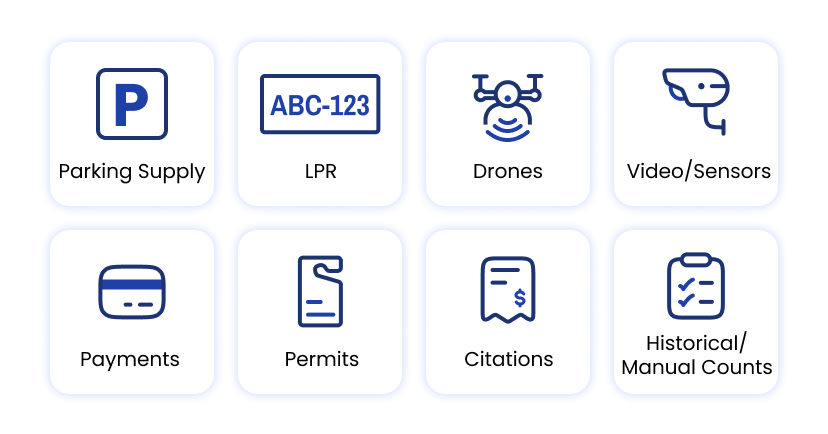
Through the DIXON Data Suite®, our team brings together parking inventory, LPR and aerial observations, sensor data, transactions, permits, citations, and other records from the agency's parking program. Each source may answer a different part of the agency's question.
Inventory defines spaces and regulations. Observations and sensors measure parking use. Transactions show payment activity and support occupancy modeling. When matched with suitable LPR observations, payment and permit records can help assess compliance. LPR observations and citation records can also help measure enforcement coverage.
Consider a block where parking is busy but payment activity is low. Comparing LPR observations with payment and permit data can help us identify potential compliance issues and determine where additional enforcement may be needed.
A transaction is not a direct occupancy count, and citation totals alone do not measure compliance. Each data source may have its limitations individually, but together they provide a more complete picture of how a parking program is functioning. The real value comes from using that information to answer questions and make more informed decisions.
Starting with the agency's question
Depending on the available data, the DIXON Data Suite® can help answer:
• Where is demand concentrated? Identify areas with consistently high or low occupancy and understand how demand varies by location, day, and time.
• How does payment activity relate to observed use? Compare observed parking activity with payments to identify potential compliance issues.
• How are permit areas functioning? Evaluate parking use and permit compliance.
• Where should staff look more closely? Compare LPR observations and citations to identify gaps in enforcement coverage.
Putting the Data to Work
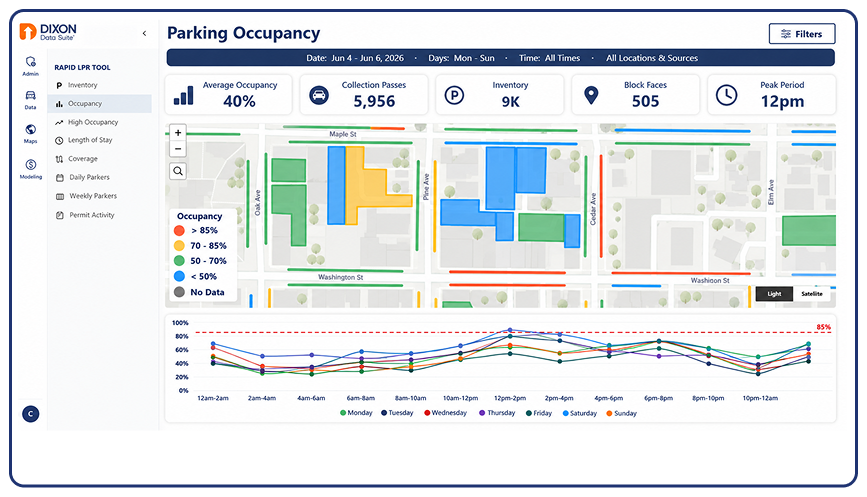
Our team helps agencies make sense of the findings, discuss options, and see what changed after a new policy or practice was put in place. This now extends beyond delivering a report at the end of a study. Agencies can revisit the results, connect them with additional information, and decide what to examine next.
But when ongoing data sources are unavailable or additional perspective is needed, targeted collection still has a role. Our team was still spending thousands of hours reviewing drone imagery and turning it into parking data. That was the next process we set out to improve.
Next in the series: The Flight Was Only Part of the Job.
Contact us today to explore how DIXON can help you achieve your goals with innovative, customized solutions.


